Flu Season Defense: How Commercial Disinfection Protects Your Workforce
Sick days cost American businesses over $225 billion a year. Here is what a real disinfection program looks like, what the EPA actually requires, and how to plan for the next respiratory season.
Every fall, facility managers brace for the same conversation: how do we keep our team healthy through respiratory season without turning the office into a hospital. The answer is not fogging machines and theater. It is a disciplined, EPA-aligned disinfection program built into your regular cleaning scope — and it is genuinely effective.
This article walks through what commercial disinfection actually is, what it is not, how to evaluate whether your current program is real or performative, and what to plan for as we move toward the 2026-2027 respiratory season.
Cleaning versus disinfecting
The single most important distinction in this conversation is the difference between cleaning and disinfecting. They are not synonyms.
Cleaning removes visible dirt, debris, and organic material from a surface. It is mostly mechanical. Soap and water and a cloth.
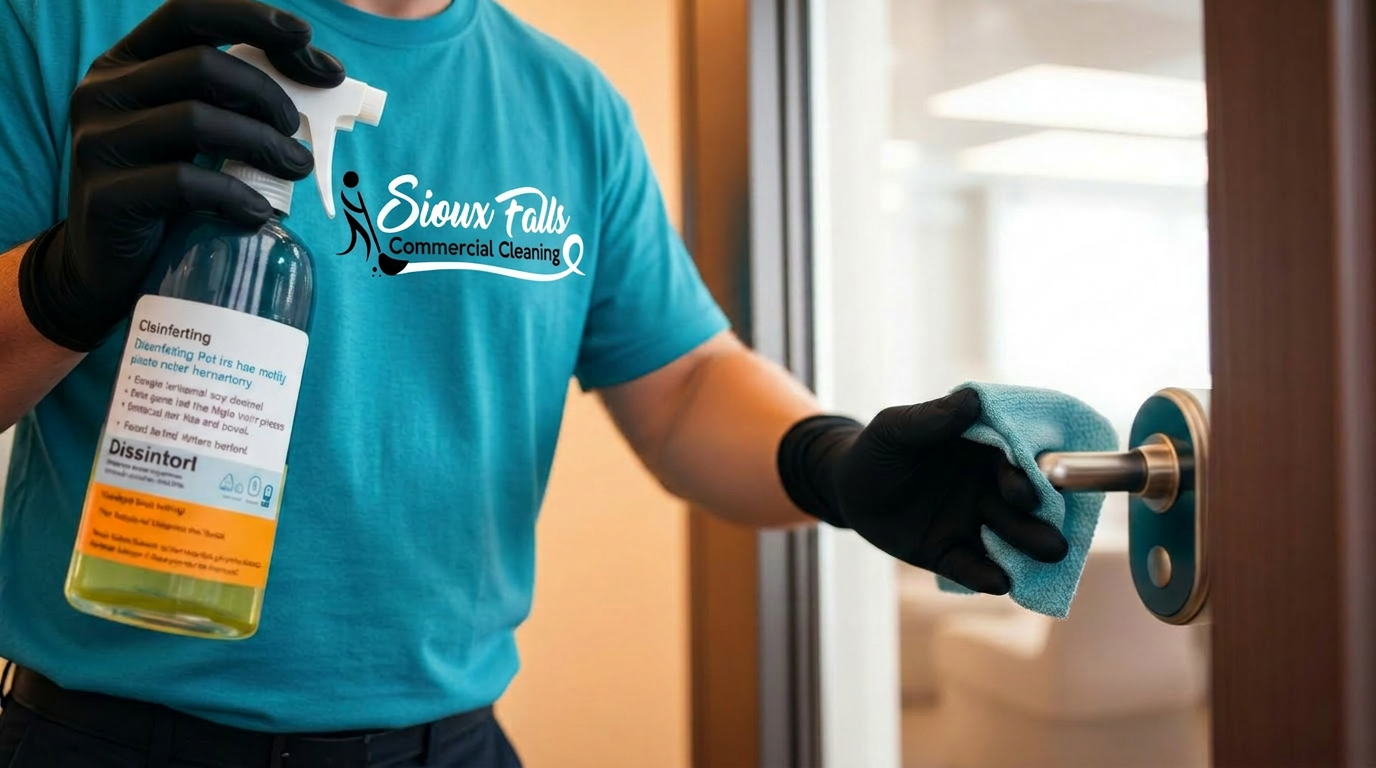
Disinfecting kills or inactivates pathogens on a surface, using an EPA-registered disinfectant applied at the correct dilution and left on the surface for the required contact time.
Disinfecting only works on a surface that has already been cleaned. If you spray a disinfectant on a surface covered in organic material, the disinfectant binds to the organic material instead of the pathogen, and you have wasted both the product and the contact time.
This is why a real disinfection program is always a two-step process: clean first, then disinfect. A cleaning crew that skips the first step is doing security theater.
The high-touch surface map
The bulk of disease transmission in a commercial building happens through a relatively small number of high-touch surfaces. In a typical office, the high-touch map looks like this:
- Entry door handles and push plates
- Light switches
- Elevator buttons and call panels
- Stair railings
- Conference room door handles and table edges
- Restroom door handles, faucet handles, and dispensers
- Breakroom: refrigerator handle, microwave handle and buttons, coffee maker, sink faucet, cabinet pulls
- Shared technology: copier touchpads, conference room remotes, shared keyboards and mice
- Reception desk and any sign-in surfaces
A well-designed disinfection program disinfects these surfaces on every visit. Not "as needed." Not "during flu season." Every visit. This is the single biggest lever for reducing workplace transmission of respiratory and gastrointestinal viruses, and it is something a competent commercial cleaning crew can build into the regular nightly scope without adding significant cost.
Contact time: the part everyone gets wrong
Every EPA-registered disinfectant has a label-specified contact time — the amount of time the surface must remain visibly wet with the product for disinfection to actually happen. Contact times typically range from 30 seconds to 10 minutes depending on the product and the pathogen.
The most common failure mode in commercial disinfection is wiping the disinfectant off the surface before the contact time has elapsed. This happens because crews are trained to "spray and wipe" instead of "clean, then disinfect, then let dwell, then wipe if needed."
A real disinfection program trains crews on contact times for the specific products they use, and structures the workflow so contact time happens naturally — typically by disinfecting at the start of a zone and returning to wipe at the end.
EPA List N and what it actually means
During the early COVID years, "EPA List N" became shorthand for "this product works against coronaviruses." That list still exists, and it is still a useful reference, but the more general principle is the one that matters: any disinfectant you use in a commercial building should be an EPA-registered product (with an EPA registration number on the label), used at the label-specified dilution, with the label-specified contact time.
If your cleaning crew cannot point to the EPA registration number for the disinfectant they are using in your building, they are not running a disinfection program. They are running a marketing program.
Electrostatic spraying: when it helps, when it doesn't
Electrostatic sprayers became very popular in the pandemic era. They work by charging the disinfectant droplets so they wrap around surfaces more evenly than traditional spraying. They are genuinely useful for high-volume disinfection of complex surfaces — gym equipment, classroom furniture, transit interiors.
For a typical office disinfection program, they are usually overkill. The high-touch surface map in most offices is short enough that crews can hit it efficiently with a spray bottle and microfiber. Electrostatic equipment is a meaningful upgrade for specific use cases (outbreak response, high-density shared spaces, post-event cleaning) but it is not a replacement for the daily discipline of disinfecting high-touch surfaces.
Restroom disinfection: the breakdown nobody talks about
If your building's restrooms are disinfected on a nightly schedule but you see fixture corrosion, grout damage, or persistent odor, the issue is almost always one of three things.
One: the wrong product. Disinfectants designed for hard surfaces are not the same as disinfectants designed for restroom fixtures. Using a quat-based disinfectant on a chrome fixture night after night will pit it over time. A real restroom program uses a fixture-appropriate cleaner first, then disinfects with a separate product matched to the surface.
Two: dilution drift. Crews running out of pre-mixed product and topping off bottles with concentrate or with water is one of the most common failure modes in commercial cleaning. The result is unpredictable chemistry and unpredictable results.
Three: missed contact time. A restroom that is sprayed and wiped in 30 seconds was not disinfected. A restroom where the disinfectant was allowed to dwell for the required contact time and *then* wiped or rinsed was disinfected. The visual result looks identical. The microbial result is very different.
Building your seasonal plan
Here is the disinfection plan we recommend to Sioux Falls businesses heading into a respiratory season:
Baseline (year-round): - Daily disinfection of all mapped high-touch surfaces, with documented contact times - Daily restroom cleaning + disinfection with surface-appropriate chemistry - Daily breakroom disinfection with food-safe products - Weekly disinfection of shared technology
Respiratory season uplift (October through March): - Add a midday "high-touch only" pass for buildings with 50+ employees - Place EPA-registered surface wipes in conference rooms and breakrooms for employee use between cleans - Brief staff on the disinfection schedule so they know what is happening
Outbreak response (when needed): - Activate electrostatic spraying in affected zones - Increase disinfection frequency to twice daily until cases drop - Document each pass for HR and insurance purposes
This plan is not expensive. For most offices, the year-round baseline is a normal part of a nightly janitorial scope, and the seasonal uplift adds a small per-visit charge for a few months a year.
What to ask your cleaning vendor
If you want to know whether your current disinfection program is real or theater, these are the questions to ask:
- Which EPA-registered disinfectants do you use in our building?
- What are the contact times for those products, and how does the crew honor them?
- Can you walk me through the high-touch surface map for our space?
- How is dilution controlled? Do you use a dispensing system or pre-mixed bottles?
- Do you document disinfection passes? Can I see a log?
- What is your protocol if there is a confirmed flu or norovirus case in our building?
A vendor running a real program will answer these in plain language. A vendor running theater will get vague or pivot to talking about how thorough they are in general.
The bottom line
Workplace disinfection is one of the single highest-ROI things a facility manager can get right. The cost is small. The difference in absenteeism is real. The difference in employee perception — knowing that someone is actually thinking about their health — is bigger than most leaders expect.
If you would like a free review of your current disinfection program and a written recommendation for the upcoming respiratory season, we are happy to do one. We will tell you what your current cleaner is doing well, what we would change, and exactly what the cost difference looks like for your building. No pressure. Most of what we recommend will be inside your current cleaning budget.
Need a cleaner you can actually count on?
Walk your building with us and get a written, flat-rate quote inside one business day.
Get a free estimateKeep reading