The Ultimate Post-Construction Cleaning Checklist for Sioux Falls Contractors
A complete, phase-by-phase post-construction cleaning checklist used by general contractors across the Sioux Falls metro. Print it, share it, and stop losing handover dates to cleaning surprises.
Post-construction cleaning is one of the most under-planned phases of any commercial build. Every general contractor we work with in Sioux Falls has a story about a project that hit every milestone — until the day before handover, when the realization hit that the building was nowhere near presentable. The cleaning crew got pulled in late, scope got renegotiated under pressure, and either the handover slipped or the owner walked through a space that was technically clean but did not feel finished.
This checklist is what we wish every GC had on day one of the build. It is the same framework our crews use on commercial projects ranging from 5,000 square foot tenant improvements to 80,000 square foot ground-ups. Print it, share it with your superintendent, and bake it into your pre-construction meeting. Your handovers will get smoother almost immediately.
The three phases of post-construction cleaning
Post-construction cleaning is not one job. It is three distinct phases, each with a different scope, a different crew composition, and a different place in the build schedule.
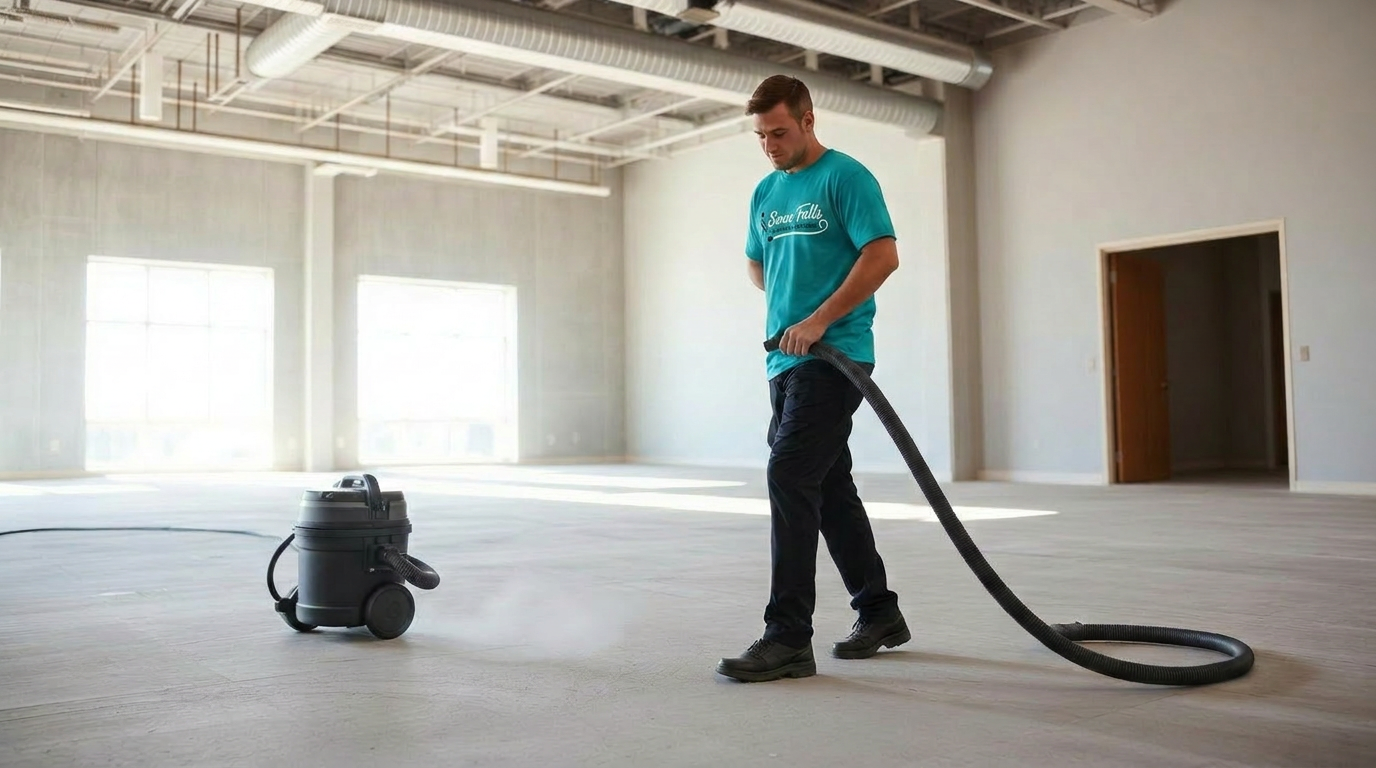
The rough clean happens after drywall and before finish trades. The goal is to remove bulk debris and construction dust so painters, flooring installers, and finish carpenters can work in a clean environment.
The final clean happens after all finishes are in and before owner walkthrough. The goal is to detail every surface so the building looks the way the architect drew it.
The touch-up clean happens between final clean and handover. The goal is to handle the inevitable smudges and footprints that accumulate during punch list walks.
Skipping any phase usually results in extra cost in a later phase. Skipping the rough clean means finish trades are wiping dust off their own workspace. Skipping the touch-up means the owner walks through a building that looked great two days ago but does not look great today.
Phase one: rough clean checklist
The rough clean should happen within 48 hours of drywall completion, before any finish work begins.
Structural - Remove all visible debris, packaging, and discarded materials from interior spaces - Sweep or vacuum all hard floors (do not wet mop yet — surfaces will be exposed) - Remove stickers, tape residue, and labels from windows, frames, and doors - Knock down accumulated drywall dust from beams, ductwork, and exposed structure - Vacuum out window tracks, door frames, and recessed hardware
Mechanical - HEPA vacuum visible HVAC supply and return registers - Wipe down installed light fixtures and remove protective film if directed - Clear debris from electrical boxes and switch backings - Vacuum elevator pits, mechanical chases, and IDF/MDF rooms
Exterior approach - Sweep entry sidewalks and remove construction debris from the approach - Clean primary entry glass to allow inspection access - Remove any temporary signage no longer needed
A good rough clean uses HEPA vacuums and dry methods almost exclusively. Wet methods at this stage drive dust into surfaces you will have to detail later.
Phase two: final clean checklist
The final clean is what most people think of when they say "post-construction cleaning." It is the longest and most detailed phase. Plan for one to two days for a typical 10,000 square foot space, more if finishes are elaborate.
Floors - Vacuum all carpet with commercial-grade equipment - Spot-treat any stains or paint drops - Sweep, dust-mop, and damp-mop all hard floors - Polish or burnish hard floors per finish specification - Clean all transition strips, baseboards, and corners
Windows and glass - Clean both sides of all interior glass (partitions, conference room walls, side lites) - Clean both sides of all exterior windows up to standard reach - Clean all mirrors and polished surfaces - Remove all stickers and protective films - Detail window frames, tracks, and sills
Walls and ceilings - Spot-clean walls for paint splatters, scuffs, and fingerprints - Dust ceiling vents, sprinkler heads, smoke detectors, and exposed conduit - Wipe down door frames, jambs, and trim - Clean both sides of every door, including hardware
Restrooms - Polish all chrome and stainless fixtures - Clean and disinfect toilets, urinals, and partitions - Clean and disinfect sinks and counters - Polish mirrors - Wipe down dispensers (do not stock unless directed) - Mop floors with neutral cleaner - Clean floor drains
Kitchens and breakrooms - Clean inside and outside of all installed cabinets and drawers - Detail appliances inside and out, including racks and drawers - Polish countertops and backsplashes - Clean and polish sink and fixtures - Mop floors and detail baseboards
Lighting and electrical - Wipe down all light fixtures and lenses - Clean and polish switch plates and outlet covers - Dust all visible AV and IT installations
Detail work - Wipe down all installed millwork and built-ins - Polish stainless steel surfaces with appropriate cleaner - Clean elevator interiors if applicable - Vacuum carpeted stairs and detail railings - Dust and wipe all signage
Phase three: touch-up checklist
The touch-up happens after the punch list walk and before the owner walkthrough. It is short — typically half a day for most spaces — but it is the difference between a building that looks clean and a building that looks finished.
- Re-clean all glass touched during the punch list walk
- Re-polish all door hardware and chrome
- Vacuum any high-traffic areas walked since the final clean
- Wipe down any surfaces that have collected dust
- Empty any trash accumulated during the punch
- Final restroom check
- Final breakroom check
- Spot-mop any heel marks or scuffs on hard floors
Scheduling notes for GCs
The biggest mistake we see is scheduling the final clean too early. If your final clean happens four days before owner walkthrough and you have active punch list work in between, you will need a substantial touch-up — and you will not have budgeted for it.
The second biggest mistake is not protecting the final clean. Once the cleaning crew leaves, lock the building. No more deliveries, no more sub work without sign-off, no more "I just need to grab my tools." Every additional person in the building between final clean and handover is a chance for the space to degrade.
The third biggest mistake is not communicating finish materials in advance. Polished concrete, terrazzo, natural stone, and certain engineered woods all require specific cleaning chemistry. A cleaning crew that finds out about a specialty finish on the morning of the final clean is a cleaning crew that is going to either delay the schedule or use the wrong product.
What to ask your post-construction cleaning vendor
Not every commercial cleaner does post-construction well. The skill set is different from recurring janitorial. Before you award post-construction work, ask:
- How many post-construction projects of this size did your team complete in the last year?
- What HEPA equipment do you bring on site?
- How do you handle specialty finishes (polished concrete, terrazzo, natural stone)?
- Will the same supervisor be on site for rough, final, and touch-up?
- What is your touch-up policy if the owner walkthrough surfaces issues?
- Are you insured for post-construction work specifically?
The answers will tell you a lot about whether the cleaner has actually done this kind of work before or is treating your project as an experiment.
A note on dust
Construction dust is not regular dust. It is finer, more abrasive, and more likely to settle inside HVAC systems and porous surfaces. Once it is in the ductwork, it will continue to recirculate for weeks after handover. The owner will notice — usually about ten days in — that surfaces are dustier than they should be in a new building.
A good post-construction cleaning program prevents this by HEPA-vacuuming registers and accessible ductwork before HVAC is run on the building's first occupancy cycle. It is not a substitute for duct cleaning, but it dramatically reduces the post-handover dust complaints that GCs sometimes get blamed for.
Final thoughts
A great post-construction clean is invisible. The owner walks in, the space looks the way they imagined it, and nobody thinks about the cleaning crew at all. That is the goal.
If you are a GC in the Sioux Falls metro and you would like a post-construction cleaning vendor that takes the schedule as seriously as you do, we are happy to walk one of your active projects with you and put together a phased proposal. We have completed post-construction work on medical office buildings, dental practices, retail buildouts, restaurant builds, manufacturing additions, and Class A office space across the region. We know what good looks like — and what the schedule cost is when good does not happen.
Need a cleaner you can actually count on?
Walk your building with us and get a written, flat-rate quote inside one business day.
Get a free estimateKeep reading